
In modern commercial and high-end residential architecture, few structural elements balance life-safety engineering and aesthetic refinement as visibly as railing systems. Whether framing a coastal resort balcony, lining a high-traffic transit terminal staircase, or providing a minimalist barrier for a corporate atrium, architectural railings must meet uncompromising safety standards while complementing the surrounding space.
Among available structural materials, stainless steel remains the premier global standard. It offers unmatched tensile strength, exceptional resistance to environmental degradation, and a timeless, clean aesthetic.
For commercial developers, general contractors, metal fabricators, and architectural specifiers, sourcing stainless steel railing systems requires a solid grasp of metallurgy, structural loading mechanics, modular installation methods, and international building codes.
1. Metallurgy Matters: Selecting the Right Stainless Steel Alloy
The term “stainless steel” covers a broad family of iron-based alloys. Specifying the incorrect grade for an application’s specific microclimate is one of the most frequent and costly mistakes in the construction industry. The two primary austenitic alloys used in architectural railing fabrication are AISI 304 and AISI 316 / 316L.
Grade 304: The Interior and Continental Standard
Grade 304 contains approximately 18% chromium and 8% nickel. It provides high yield strength, excellent formability, and reliable resistance to atmospheric corrosion in indoor applications, climate-controlled spaces, and mild continental outdoor environments. For corporate interiors, dry-zone staircases, and standard multi-family developments situated away from the ocean, Grade 304 delivers solid structural integrity and visual appeal at an economical cost.
Grade 316 and 316L: The Marine and Extreme-Duty Baseline
Grade 316 introduces 2% to 3% molybdenum into the alloy matrix. This structural addition significantly improves the metal’s resistance to chloride-induced pitting and crevice corrosion.
In environments within 10 to 15 kilometers of salt water, adjacent to chlorinated swimming pools, or exposed to heavy winter de-icing salts, Grade 304 will inevitably develop surface staining (commonly referred to as “tea staining”). Grade 316 and low-carbon 316L form a dense, self-healing chromium-molybdenum oxide passive film that prevents localized chloride breakdown.
| Technical Parameter | AISI 304 | AISI 316 | AISI 316L |
| Tensile Strength (MPa, min) | 515 | 515 | 485 |
| Yield Strength (0.2% Proof, MPa, min) | 205 | 205 | 170 |
| Molybdenum Content (%) | — | 2.0 – 3.0 | 2.0 – 3.0 |
| Carbon Content (%, max) | 0.08 | 0.08 | 0.03 |
| Optimal Environment | Dry Interior / Urban Inland | Coastal / Industrial / Humid | Marine Welded Structures / Chemical |
| Resistance to Chloride Pitting | Moderate | High | Superior |
2. Core Architectural System Typologies
As a dedicated manufacturer, our production lines fabricate diverse railing configurations designed to address distinct architectural intents, load distributions, and project budgets:
A. Post-and-Glass Clamped Systems
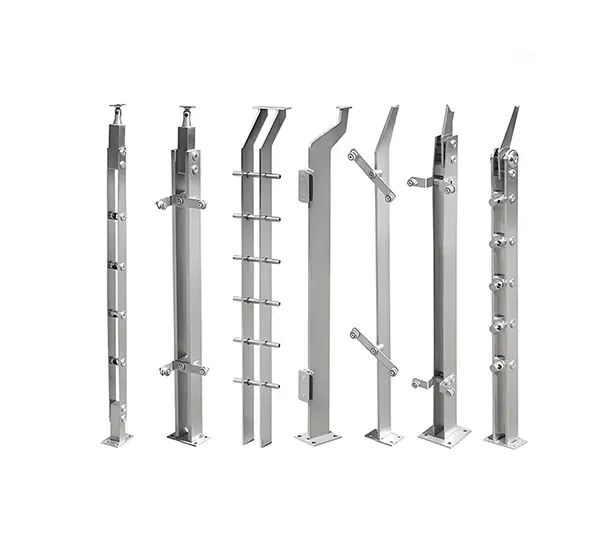
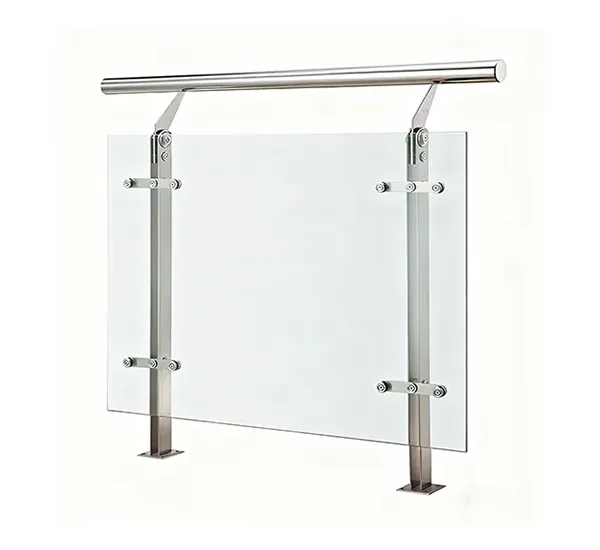
Balancing physical protection with open sightlines, post-and-glass systems feature vertical stainless steel posts (round pipe, square tube, or twin flat bar) fitted with engineered glass clamps.
- Mechanics: Clamps hold monolithic tempered or laminated glass panels securely using heavy-duty EPDM or silicone rubber gaskets.
- Safety Feature: High-spec clamps incorporate internal mechanical shelf pins that mechanically anchor through pre-drilled holes in the glass, preventing panel slippage over time even under heavy thermal cycling.
B. Stainless Steel Cable (Tension Wire) Systems
Cable railings are the premier choice for modern, industrial, and landscape-integrated architecture where minimal visual obstruction is the priority.
- Cable Construction: Assemblies utilize 1×19 structural stainless steel strand (rigid, minimal stretch) or 7×7/7×19 flexible wire rope, typically ranging from 3.2 mm (1/8″) to 4.8 mm (3/16″) in diameter.
- Hardware: Precision swaged turnbuckles, concealed threaded tensioners, and clean intermediate grommets maintain structural cable tension without visible bulky fittings.
C. Glass Spigot and Base Shoe (Framer-Free Balustrades)
For uninterrupted, frameless architectural views, base-mounted spigots (core-drilled or surface-flanged) and heavy structural U-channel base shoes grip heavy laminated glass (typically 12 mm to 21.5 mm thickness) purely from the bottom edge.
- Engineering: Heavy investment-cast duplex 2205 or 316 stainless steel spigots provide the localized bending-moment resistance necessary to anchor tall glass panels without top handrails.
D. Industrial and Continuous Rod Balustrades
Replacing horizontal cables with solid stainless steel rods (typically 8 mm to 12 mm diameter) offers a rigid, robust visual profile. Horizontal rod systems eliminate the need for ongoing cable re-tensioning, making them ideal for high-traffic public infrastructure, rail platforms, and educational institutions.
3. Surface Finishing: Science, Cleanliness, and Longevity
The corrosion resistance of stainless steel is not merely a bulk property—it depends entirely on the integrity of its surface finish. Microscopic surface roughness traps airborne salts and particulates, creating localized galvanic cells that trigger premature corrosion.
- Brushed Satin Finish (#4 / 240–320 Grit): The architectural benchmark. Characterized by fine, unidirectional grain lines that disperse harsh reflections and mask everyday fingerprint smudges. High-precision linishing keeps surface roughness below $Ra < 0.5 \ \mu\text{m}$, balancing visual warmth with cleanability.
- Mirror Polished Finish (#8): Buffed to a reflective, non-directional finish ($Ra < 0.1 \ \mu\text{m}$). Beyond its bright luxury aesthetic, mirror polishing is functionally superior for high-salinity marine applications: with no micro-grooves for salts to cling to, it offers optimal natural corrosion resistance.
- Pickling and Chemical Passivation: Every manufactured component undergoes an acid-bath treatment (typically nitric or citric acid blends) to remove free embedded iron left behind by tooling, followed by controlled passivation that deepens the protective chromium-oxide barrier.
- PVD (Physical Vapor Deposition) Titanium Color Coatings: For projects requiring decorative color without sacrificing durability, PVD coating deposits a micro-thin, ultra-hard ceramic layer (such as Titanium Nitride) over the stainless substrate. This provides deep Matte Black, Satin Brass, Rose Gold, or Gunmetal Gray finishes that will not chip, peel, or degrade under UV exposure like conventional paint or powder coating.
4. Structural Safety Codes and Mechanical Testing Compliance
Architectural railings are life-safety systems designed to arrest human falls from height. Sourcing compliant systems requires verifying performance against global structural building codes:
IBC (International Building Code – North America)
- Concentrated Point Load: Handrails and top guards must resist a single concentrated load of 200 lbf (0.89 kN) applied in any direction at any point along the top rail (IBC Section 1607.8.1).
- Uniform Linear Load: Guards must withstand a uniform load of 50 lbf/linear foot (0.73 kN/m) applied horizontally outward at the top of the rail.
- Infill Loading: Cable infill, balusters, and glass panels must withstand an independent horizontal load of 50 lbf (0.22 kN) over a one-square-foot area.
- The 4-Inch Sphere Rule: Intermediate openings (infill spacing between cables, rods, or pickets) must not allow passage of a 4-inch (102 mm) diameter sphere up to a height of 36 or 42 inches.
European and British Standards (EN 1991-1-1 / BS 6180)
Classifies barriers based on occupancy zones (domestic, office, retail, public gathering). Design line loads range from 0.74 kN/m for private residential up to 1.5 kN/m to 3.0 kN/m for crowded public venues and sports arenas.
In-House Testing and Validation
To guarantee compliance, our factory subjects all post designs, base plates, glass brackets, and tension terminals to rigorous physical validation:
- Static Push-Pull Hydraulic Testing: Verifying deflection limits without exceeding elastic thresholds or exhibiting plastic failure.
- Dynamic Impact Testing (Pendulum / Drop-Bag Test): Simulating heavy human impacts on glass infills and mechanical posts.
- Continuous Salt Spray Testing (ASTM B117 / ISO 9227): Evaluating alloy and finish performance under concentrated neutral and acidified salt-fog exposure for 1,000+ hours.
5. The Manufacturer Advantage: Engineering, Tooling, and Modular Assembly
For general contractors and architectural metal shops, on-site field fabrication—such as measuring, cutting, welding, grinding, and field-polishing raw stainless steel—is labor-intensive, slow, and prone to surface contamination.
We bridge this operational gap through modular, pre-engineered OEM/ODM manufacturing:
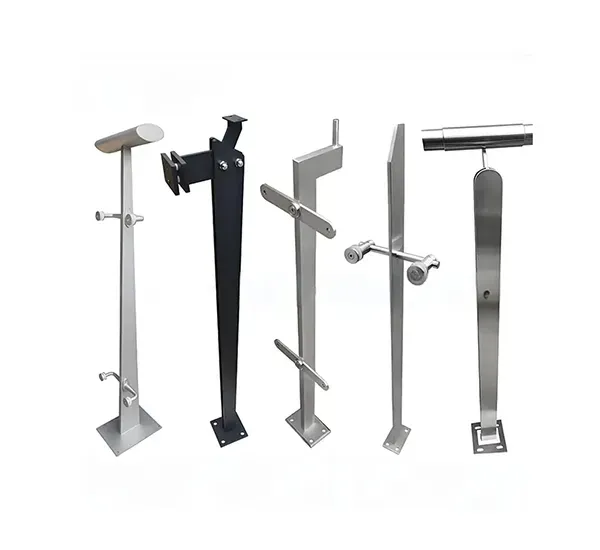
A. Pre-Drilled, CNC-Machined Modular Posts
Our robotic CNC machining centers laser-cut tube profiles, flow-drill post walls, and form clean internal metric threads for clamp and cable fittings. Base plates are welded using automated orbital TIG and laser-welding setups, followed by automated bead-blasting and pickling to eliminate heat-tint discoloration.
B. Weld-Free Mechanical Installation
Our modular architectural components utilize internal mechanical wedge connectors, structural compression splices, and heavy-duty blind rivet systems. Installers assemble complete handrail runs, wall returns, and 90-degree corner joints on-site using standard Allen tools and structural adhesives, cutting site installation time by up to 60%.
C. Turnkey Component Ecosystem
We supply completely unified systems:
- Investment cast base flanges, deep cover roses, and heavy expansion anchors.
- Flush end caps, adjustable multi-angle elbow connectors, and wall brackets.
- Precision swaged cable fittings, tension rods, and heavy cast-glass spigots.
- Integrated architectural LED handrail channels with concealed wire pass-throughs for ambient pathway illumination.
Elevate Your Next Commercial or Residential Project
A properly engineered stainless steel railing is a functional safeguard and a striking architectural accent. It must maintain structural rigidity under sudden dynamic impact, resist ambient atmospheric decay over decades of seasonal changes, and deliver a clean, high-precision tactile experience to building occupants.
By controlling every stage of the manufacturing workflow—from raw spectrographic ingot verification and investment casting to precision CNC machining, surface finishing, and compliance loading tests—we supply the global construction market with durable, code-compliant, and visually refined railing systems.
Partner with our engineering team on your next architectural project. Contact us today to request technical 2D/3D BIM/CAD files, discuss custom OEM tooling, or order structural sample packages for project mock-ups.